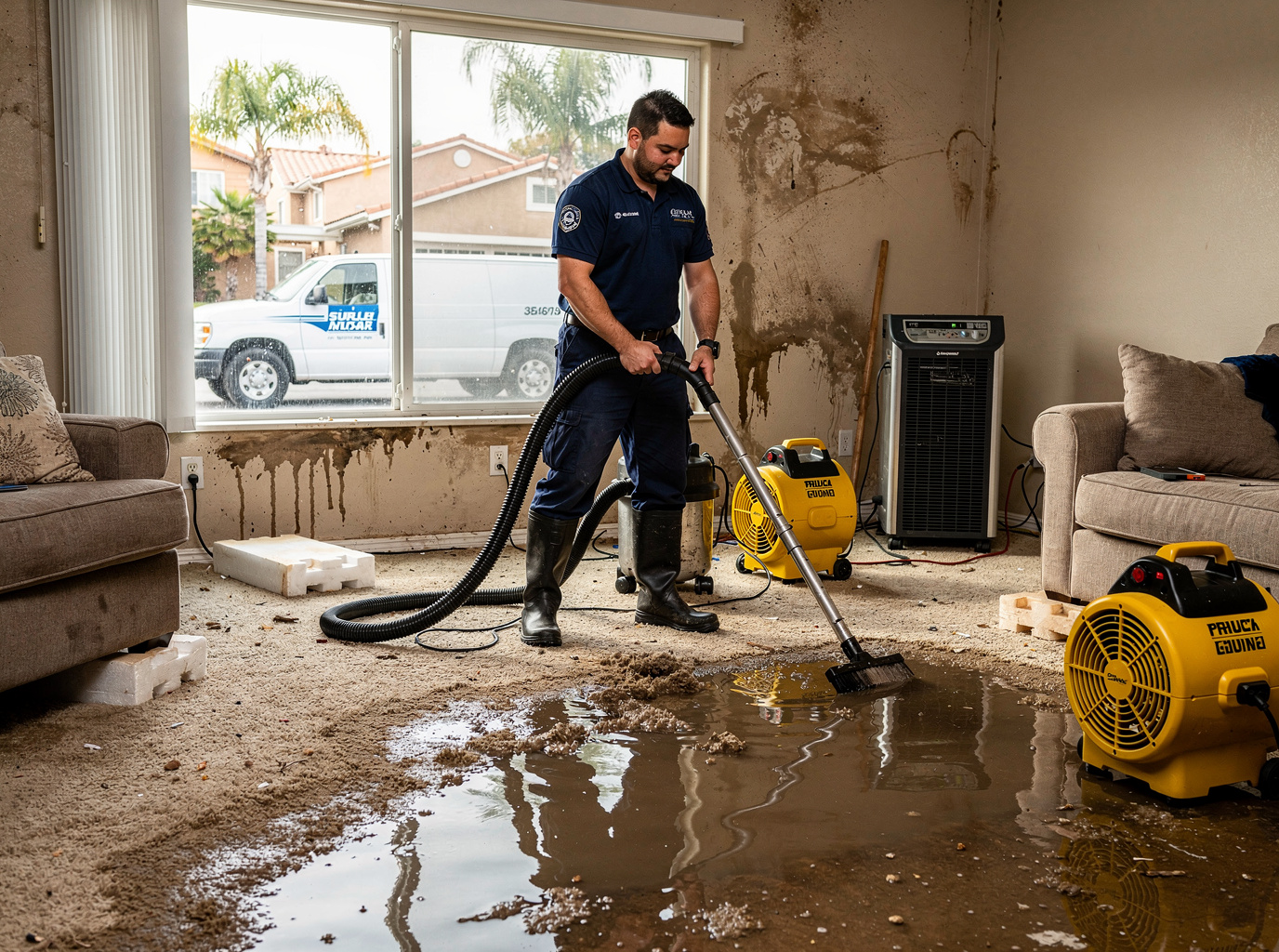
Chula Vista's mild coastal Mediterranean climate keeps humidity levels high even in winter, so standing water in slab homes common in Eastlake and Otay Ranch can wick into concrete and subfloors faster than inland areas. Older stock around Third Avenue Village and National City borders often has original plumbing that fails without warning, sending water under cabinets and into wall cavities before residents notice. Technicians must pull baseboards early and use moisture meters on every joist because hidden saturation here leads to mold within 48 hours when evening marine layers roll in.
San Diego County building codes require permits for any structural drying that affects load-bearing walls, so crews working in Bonita and Imperial Beach properties document every step before cutting drywall. Flat lots near Otay Lakes trap runoff during rare heavy rains, pushing water against foundations on properties built before modern grading standards. Extraction equipment must handle both fresh supply-line breaks and contaminated Category 3 water from street flooding that backs up through floor drains in Downtown Chula Vista.
Portable desiccant dehumidifiers run longer here than in drier inland zones because ambient moisture re-enters the space overnight. Technicians place sensors at multiple heights in two-story homes common in Eastlake to catch moisture that migrates upward through HVAC returns. Every job ends with a written drying log that homeowners can show insurers, because claims adjusters familiar with San Diego County coastal properties expect proof that relative humidity stayed below 50 percent throughout the process.
Technician insight
In Chula Vista the thing that catches most people out with Emergency Water Damage Restoration is how the marine layer keeps humidity above 60 percent at night, so even after extraction you have to run dehumidifiers longer in slab homes around Otay Ranch than the same job would need inland. Homeowners often stop fans too soon once the floor feels dry, but the real moisture sits under baseboards and in the subfloor where older plumbing runs.
Eastlake Slab Leak
A supply line under the kitchen slab failed overnight in an Eastlake home. Water traveled under the tile and into the adjacent laundry room before the homeowner noticed. Crews extracted standing water, opened the toe-kick areas, and placed drying equipment for four days until moisture readings matched the rest of the house. The homeowner avoided cabinet replacement and the insurance claim closed with the drying log provided.
Emergency Water Damage Restoration Services We Offer
✓Burst Pipe Water Extraction
Immediate removal of water from supply line failures common in 1970s-1990s tract homes throughout Eastlake and Otay Ranch before walls are opened.
✓Appliance Leak Containment
Rapid isolation and drying after refrigerator, washer or water heater leaks that soak cabinet bases and subfloors in single-story Bonita properties.
✓Storm Runoff Cleanup
Extraction and antimicrobial treatment for water that enters through doors and windows during heavy winter rains near Otay Lakes and low-lying Downtown streets.
✓Sewage Backup Remediation
Full removal and disinfection of Category 3 water that backs up through floor drains in older Third Avenue Village buildings and National City border homes.
✓Ceiling and Wall Cavity Drying
Targeted drying of water that migrates upward from upper-floor leaks into drywall and insulation in two-story homes common in Eastlake.
Emergency Water Damage Restoration Cost in Chula Vista, CA
| Service | Typical Range | What Affects It |
|---|---|---|
| Emergency Assessment And Extraction | $250–$650 | Varies with water depth and whether Category 3 contamination is present |
| Full Structural Drying | $800–$2,200 | Depends on number of rooms and whether walls or ceilings must be opened |
| Antimicrobial Treatment | $150–$400 | Added when sewage or gray water is involved |
| Final Moisture Verification | $100–$200 | Included when full restoration package is selected |
Ranges are typical for Chula Vista, CA and confirmed with an exact written quote before any work starts.
How it works
- 1
On-Site Assessment
Technician arrives within the service window, maps all affected materials with moisture meters, and photographs every room for insurance documentation.
- 2
Water Removal
Truck-mounted and portable extractors pull standing water from carpets, pads and hard surfaces while containing any contaminated flow.
- 3
Structural Drying
Air movers and dehumidifiers are positioned based on construction type, with daily moisture readings logged until levels match unaffected areas.
- 4
Final Clearance
All equipment is removed only after independent verification that hidden cavities are dry and surfaces pass visual and meter inspection.
Pricing
Upfront written quotes after inspection; price depends on water category, square footage and how many cavities require opening.